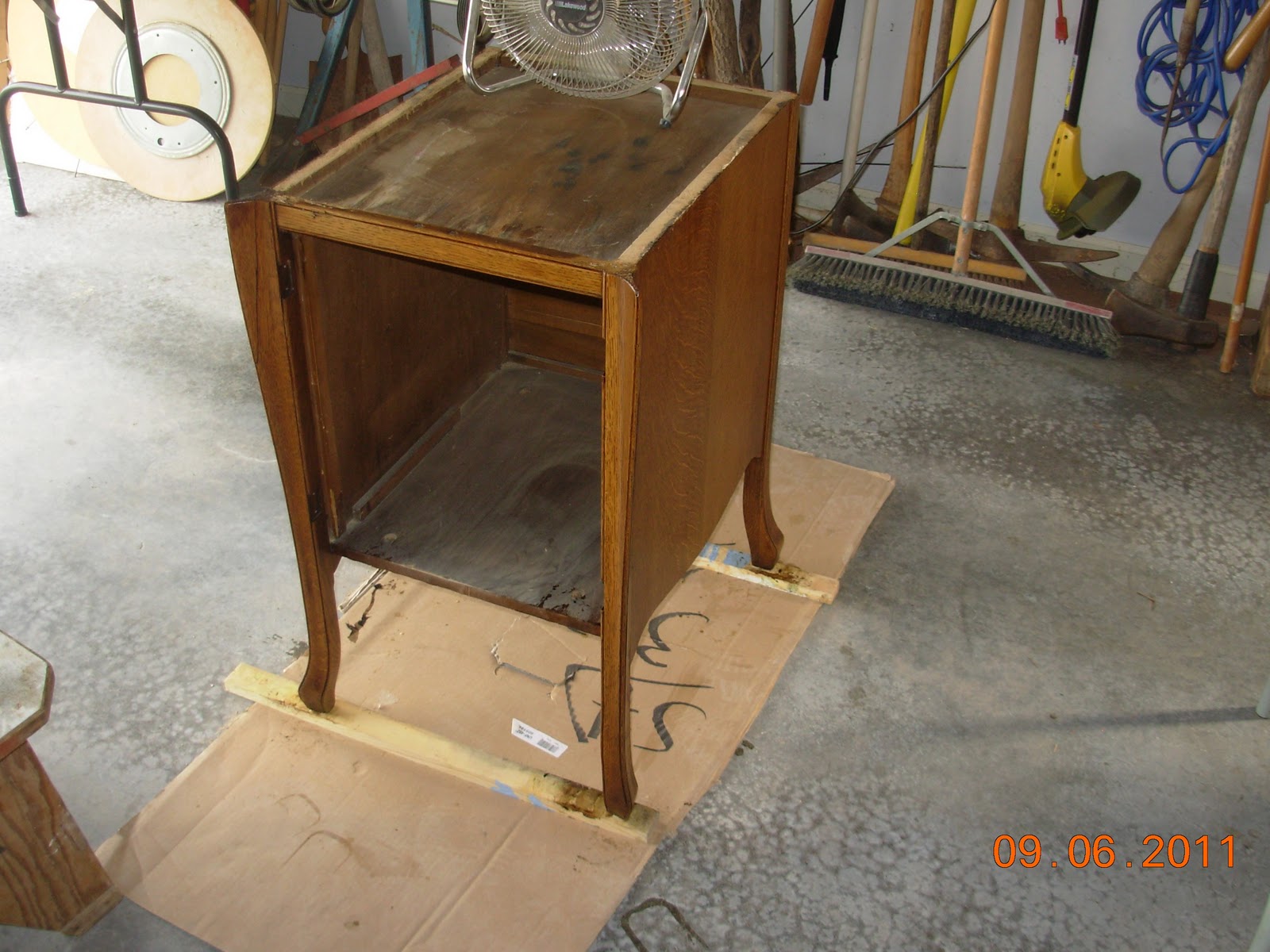
8-15-09: We found this old Wash Basin at an auction in Hot Springs, SD, on Aug 14, 2009. It was painted with about three coats of brown and tan paint. We didn't know much about it until we started taking the top apart to repair and re-glue the three boards that made up the top. The legs and sides were doweled together and came apart easily, but then we found the nails. At first I thought it had been repaired at one time with nails instead of disassembling and re-gluing. However, the further we went, the more it looks like it was put together with nails and dowels from the get-go. The nails were iron, square-cut, and about 1 3/8" to 2" long with a square tip. At this point, we suspected this was probably a pretty old piece.
.JPG)
So we did a little research on square nails and discovered that this same type of nail used to be hand-forged; later, in the early 1800's, they were manufactured in nail mills in the northeastern US. Round, or wire nails, didn't appear on the scene until the 1900's. Finding square-cut nails in the furniture piece proved that the item was at least older than us or either of our parents.
.JPG)
Other information we dug up: "Square-cut nails" are also called "steel-cut nails", or sometimes just "square nails". Hand-forged nails were the first manufactured nails, and they date back to Biblical times. As people first used hewn beams, timbers, planks, and whole logs to build with, the early hand-made nails were spikes. With the development of the split wood shingle, nails of about 1" long came into use. When sawyers, and then sawmills, began cutting dimension lumber, the sizes and varieties of nails greatly expanded. Over time, nails developed in different sizes, shapes, and used different heads to fasten lumber and wood.
Nails have always been in demand. Some blacksmiths made only nails and they were called "Nailers." We learned that nails were so scarce (and expensive) in pre-1850 America, that people would burn dilapidated buildings just to sift the ashes for nails. They did so because pulling the nails would have damaged most of them. After the nails were recovered, a blacksmith could easily straighten any nails that had been bent during construction. The cut nail made its appearance in the mid-1700's. It would not be until the middle-1800's that cut nails began common and dominated the marketplace. Cut nails are not actually "cut"--they are sheared from steel plate that is the thickness of the nail shank. Although most often referred to as "square nails", the cutting machine tapers the nail shank as it is sheared from the steel plate. A second machine forms the head of a cut nail. The square nails we found in the wash basin were probably made in this manner.
With the hand-forged nail, all four sides are tapered. With the cut nail, two sides are parallel because they represent the thickness of the plate they were sheared from. Cut nails had their heyday from about 1820 (development of the Type B nail) to 1910, the advent of the wire nail that we use today. Wire nails are round. Steel wire is fed into a machine that grips the wire, cuts it, makes the head, and chisels the point, all in one operation.
.JPG)
.JPG)
.JPG)
.JPG)
As we began to strip the paint, we found some writing on the back of the drawer:
"1882 to O.P.P. Sie"
We interpreted this to mean the furniture was either built in 1882 or at least given in 1882 to someone with the initials of O.P.P., which is definitely in the right time frame (between mid 1800s and 1910)that was called out in our research on nails. (Not sure what Sie means.) With this info, we are assuming that the wash basin is at least 117 years old.
.JPG)
9-3-09: We now have the item pretty much stripped of paint, and most of the repairs made. The wood is similar in grain and color to ALDER. The square head of the nails did a number on the wood surface when we pulled out the nails. Some repair to the top will be required to fill in the surface where each nail was pulled out when we disassembled the wide top piece. The item definitely has potential for being a super conversation piece.
.JPG)
.JPG)
the end




.JPG)
.JPG)
.JPG)
.JPG)
.JPG)
.JPG)
.JPG)
.JPG)
.JPG)
.JPG)
.JPG)
.JPG)
.JPG)
.JPG)
.JPG)


